Final Freeway 2R
- 4.6
- Rating
- 10.00K
- Installs
- $1.99
- Price
 Analysis by App-foxy
I came away from Final Freeway 2R with the feeling that it understands something many modern racing games forget: a short drive can be enough. This is a paid racing game from NEWTYPE, the Japanese developer, and its appeal is not built around a huge garage, a long campaign, or a complicated progression system. It is about choosing a character, taking a route, and enjoying the immediate rhythm of driving through a fast-moving freeway setting.
That focus makes it easy to understand but harder to judge by modern mobile standards. I would not recommend it to someone looking for a realistic simulator or a large, constantly expanding racing package. I would recommend it to someone who wants a quick arcade-style drive that feels more like an interactive road trip than a serious motorsport competition. The important question is whether that compact idea is worth paying for.
What the paid purchase gives you
The verified price is $1.99, so this is not a free download that depends on optional spending to define the experience. That distinction matters. You are making a straightforward purchase decision: pay $1.99 for the game, rather than entering a free-to-start racing app whose value may depend on additional purchases. I appreciate that clarity, especially for a game designed around quick sessions.
You May Also Like

 AccuWeather: Weather Radar
AccuWeather Review: A Quick, Clear Forecast for Everyday Decisions
For everyday plans, the best forecast is the one you can understand quickly. AccuWeather makes rain timing, radar, and local conditions easy to act on, with a few trade-offs.

 Hill Climb Racing
Why Hill Climb Racing Still Turns Crashes Into One More Run
A tiny car, a bumpy hill and one more upgrade: Hill Climb Racing keeps resurfacing because its simple chaos makes every near-miss feel personal.

 AliExpress - Shopping App
AliExpress Makes Global Shopping Feel Personal, but Shoppers Bear the Risk
AliExpress turns a global marketplace into a pocket-sized discovery engine. Its reach is useful, its shopping loop compelling, and its trade-offs easy to miss.

 Lords Mobile: Kingdom Wars
Lords Mobile Is a Kingdom-Building Routine, Not a Quick Match
A case-by-case verdict on the building, battles, device demands, and social commitments that make Lords Mobile rewarding for some players and exhausting for others.

 PDF Scanner app - TapScanner
TapScanner Makes Paperwork Easier to Capture, Check, and Share
TapScanner makes scanning with a phone feel less like a rescue operation and more like a dependable step in getting work done. Its capture tools are useful, though not flawless.

 Block Blast!
 Shows How Much a Puzzle Game Can Leave Out
A quiet grid game shows why puzzle players increasingly value instant clarity, repeatable skill and low-pressure play—and where the genre still needs to catch up.
More From Our News Desk
View All News


The price also sets a reasonable expectation. I see this as a small arcade game rather than a replacement for a full console-style racer. Its value comes from how quickly it gets me into a drive and how pleasant it is to replay, not from the amount of content suggested by a large modern racing catalogue. If you want extensive car ownership, deep tuning, or a broad online community, this purchase is unlikely to satisfy that particular expectation.
Final Freeway 2R is listed for Everyone, which fits the approachable nature of its premise. I can imagine handing it to a younger player without the subject matter itself being a concern, while an adult may enjoy it for the same reason: there is little barrier between opening the game and getting on the road. The age rating does not mean every player will enjoy the style, though. A simple arcade format can feel refreshing to one person and limited to another.
The game was released on Apr 14, 2012, and the current version is 1.10.6.3. It supports Android 7.0 and later. Those details are useful when deciding whether it belongs on an older compatible device, but they also frame the experience: this is an established, compact game with a deliberately focused identity rather than a new racing production built around current hardware.
A quick drive rather than a long campaign
My favorite part of the design is the lack of ceremony. The basic idea is immediately readable: choose a character, select a direction or path, and drive. That choice of path gives each run a little purpose beyond simply holding the accelerator. I found myself paying attention to the road ahead because the route decision makes the drive feel personal, even when I was only playing for a few minutes.
This is particularly effective in everyday situations. If I have a short break while waiting for an appointment, I do not want to remember a complicated upgrade tree or complete several races before the game becomes enjoyable. A quick session with this title can work better because the main attraction is available immediately. It is also a comfortable choice when I want something active but not mentally demanding.
The trade-off is that this kind of immediacy can reduce long-term motivation. A player who needs unlocks, collections, detailed statistics, or a strong competitive ladder may run out of reasons to return. The route choice adds replay interest, but it should not be mistaken for the depth of a full career mode. I would buy it for repeatable arcade driving, not for a progression-heavy hobby.
Why the character and route choice matter
The character selection is more than a decorative first screen because it helps establish the game’s personality. I like that the player begins by making a choice rather than being pushed through a long introduction. That contributes to the sensation that each drive is a small outing with its own direction.
The route decision is the more meaningful of the two choices. Instead of treating every run as an identical loop, the game asks me to think about where I want the drive to go. My practical tip is to avoid choosing the same path automatically. Alternating routes keeps the experience fresher and lets the game’s branching idea do more work than it would if I treated it as a single repeated course.
There is also a useful difference between playing for relaxation and playing for mastery. On a casual run, I can simply enjoy the pace and scenery. On a more focused run, I can use the route choice as a reason to compare how each drive feels and which decisions produce the most satisfying outcome. That gives the game a small but genuine layer of experimentation without pretending to be a complex simulation.
Arcade character versus realistic racing
I would place this much closer to classic arcade driving than to a realistic racing simulator. The pleasure comes from momentum, quick decisions, and the sensation of moving through a lively freeway environment. It is not the kind of game I would open when I want careful braking points, vehicle setup, tire strategy, or a convincing recreation of professional racing.
That comparison helps explain both its strength and its limitation. Against a large free racing game, Final Freeway 2R may appear modest because it does not compete through scale. It competes through focus. There is less to manage, so I can concentrate on the drive itself. The usual alternative is better for someone who wants a broad catalogue of vehicles and events; this game is better for someone who finds that breadth distracting.
It also differs from endless runners that use roads mainly as a backdrop for collecting items or surviving as long as possible. Here, the act of choosing a path gives the journey a more deliberate structure. I am not only reacting to obstacles in an endless stream; I am taking part in a compact road adventure. That distinction is subtle, but it is the reason the game feels like its own thing rather than a generic traffic game.
Where the experience can feel dated
The game’s age is part of its character, but it can also create friction. Players accustomed to contemporary mobile racers may expect more elaborate presentation, a larger selection of activities, and a stronger sense of ongoing progression. This title’s directness may feel charming at first and sparse later, especially if I normally judge racing games by how much content they offer over many weeks.
The paid format makes that limitation more noticeable because the initial purchase asks me to decide on the complete value proposition. With a free game, I could sample the basic loop without spending anything. Here, I need to be comfortable with the idea that the attraction is a focused arcade drive, not an enormous package. The low price helps, but it does not change the type of game being purchased.
Another trade-off is audience size. The game has an average rating of 4.6 from around 815 ratings, with around 104 written reviews, and it has passed 10K installs. Those figures suggest a positive response among its audience, but they do not guarantee that it will match the tastes of someone coming from a different style of racer. I read them as encouragement to investigate, not as proof that the game offers the depth of a mainstream racing hit.
Small habits that improve a session
I get more from the game when I treat each run as a complete miniature experience. Rather than opening it expecting a long play session, I choose a character, commit to a path, and let the drive stand on its own. This makes the compact design feel intentional instead of incomplete.
I also recommend changing the purpose of each session. One run can be about relaxing and enjoying the road; another can be about paying closer attention to the route decision; a third can be a quick test during a spare moment. This simple variation prevents me from judging every play session by the same standard. It is a useful approach for a game whose appeal is repetition with small changes rather than constant novelty.
For a shared device, the straightforward controls and Everyone rating make it easier to introduce to family members who do not normally play racing games. I would still explain that it is an arcade experience, not a realistic driving lesson. That expectation-setting matters: the game is enjoyable when approached as a stylish, accessible drive, but it is not the right tool for learning real road behavior or racing technique.
Who should spend the $1.99
I think the purchase makes the most sense for players who enjoy short, self-contained arcade games and like the idea of choosing a route during a drive. It is a good fit if you want something that starts quickly, does not require a large commitment, and offers a distinctive freeway-focused mood. Fans of older arcade racing traditions may also appreciate its uncomplicated structure.
It is especially suitable for someone who dislikes the pressure often associated with free-to-play racing. Since the confirmed cost is a single $1.99 purchase, the decision is clear from the start. I can evaluate the game based on whether its driving loop is appealing, rather than wondering how much a complete experience might eventually cost.
I would skip it if my priority were realism, extensive customization, online competition, or a deep career. I would also be cautious if I need a game that supplies a new objective every time I open it. The route selection provides variety, but it does not transform the game into a content-heavy racer. In that situation, a broader racing alternative would be a better use of both storage and money.
My buying verdict
For me, Final Freeway 2R earns its place as a focused arcade racer with a clear personality. NEWTYPE keeps the central idea simple: pick a character, choose a direction, and enjoy the drive. That simplicity is the reason I can recommend it, but it is also the reason I would not present it as an all-purpose racing game.
At $1.99, I see convincing value for the right player because the purchase is direct and the experience is easy to return to in short sessions. The strongest reason to buy is not the amount of content; it is the specific feeling of taking a quick, branching freeway drive without the management and monetization concerns commonly attached to larger mobile racers.
My final advice is straightforward: buy it if that compact arcade road-trip idea sounds appealing and you are happy with replaying a focused experience. Skip it if you want a realistic simulator, a large progression system, or a free trial before committing. The best value here comes from fit, not scale—and for the right kind of racing fan, that can be enough.
FAQs for Final Freeway 2R
01What is Final Freeway 2R?
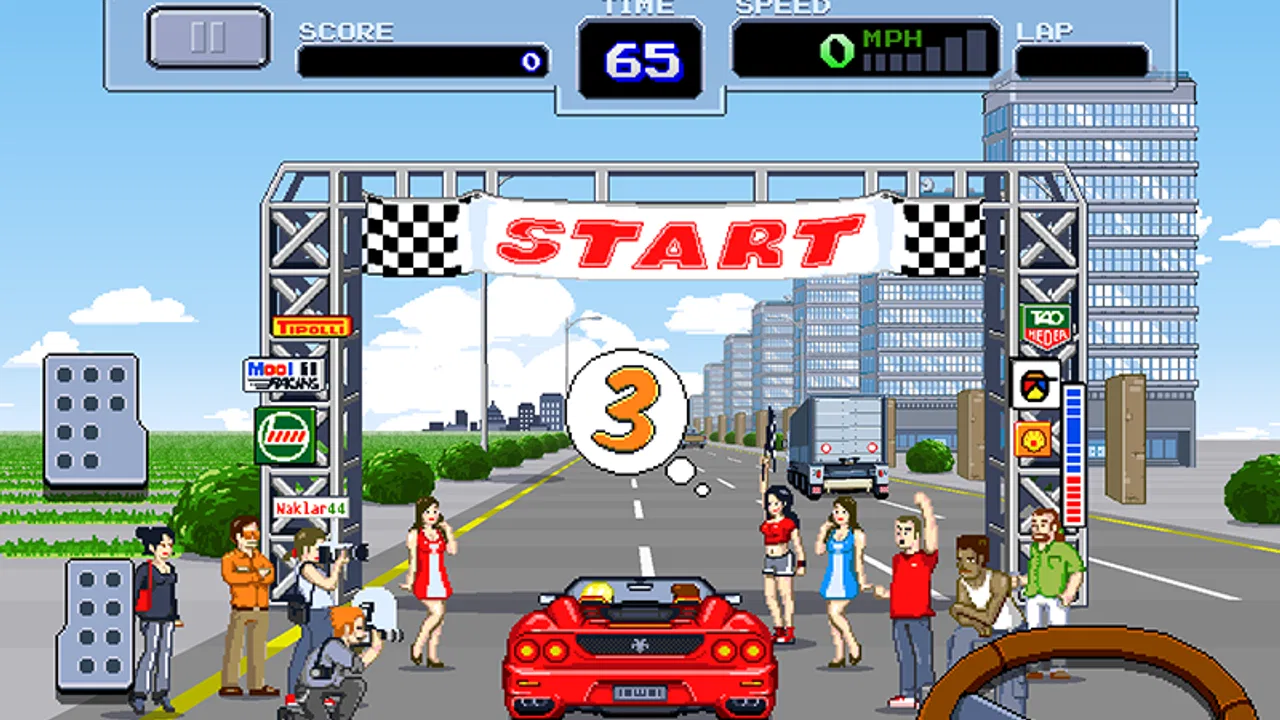
Final Freeway 2R is a retro-style arcade driving game inspired by classic 1980s highway racers. You drive a fast sports car through colorful roads, passing traffic, choosing routes, and trying to reach the finish before time runs out. Its emphasis is on quick reflexes, simple controls, upbeat music, and nostalgic presentation rather than realistic simulation or complex vehicle customization.
02How do you play Final Freeway 2R?
Gameplay is straightforward and designed for short, replayable sessions. You steer through traffic, accelerate, brake when necessary, and select different routes at junctions. The goal is to maintain speed while avoiding crashes and reaching checkpoints or destinations within the available time. The controls are easy to understand, although mastering cornering, overtaking, and route choices takes practice as the speed increases.
03Does Final Freeway 2R work offline?
Final Freeway 2R is primarily a self-contained arcade game, so its main driving experience can generally be enjoyed without a constant internet connection. This makes it suitable for travel, commuting, or quick sessions when mobile data is unavailable. However, store requirements, advertising behavior, updates, or optional platform services may vary by device and version, so checking the download page is recommended.
04Is Final Freeway 2R suitable for children and casual players?
The game is generally accessible to casual players because it uses simple driving mechanics and does not require extensive tutorials or complicated menus. Its colorful retro visuals and non-realistic arcade style can appeal to a wide audience. Nevertheless, the fast pace may be challenging for younger players, and parents should review the current store listing for age ratings, advertising, and any purchase-related information.
05What are the main advantages and drawbacks of Final Freeway 2R?
Its main strengths are the nostalgic arcade presentation, responsive pick-up-and-play controls, energetic soundtrack, branching routes, and strong replay value for players who enjoy improving their times. The experience is intentionally simple, so it may feel limited if you expect realistic physics, deep customization, online multiplayer, or a long story campaign. Some players may also find repeated routes and races less varied over time.
Pros
- Fast
- responsive controls make drifting and overtaking feel satisfying.
- Retro pixel-art visuals run smoothly on a wide range of devices.
- Multiple routes and endings add replay value beyond a single playthrough.
- The soundtrack captures the energy of classic arcade racing.
- Short races are ideal for quick gaming sessions on mobile.
Cons
- The basic driving mechanics may feel repetitive after extended play.
- Traffic patterns can sometimes seem unpredictable or unfair.
- Limited vehicle customization may disappoint racing enthusiasts.
- Some routes and content require repeated play to unlock.
- The retro presentation may not appeal to players seeking realistic graphics.

Final Freeway 2R
Gallery